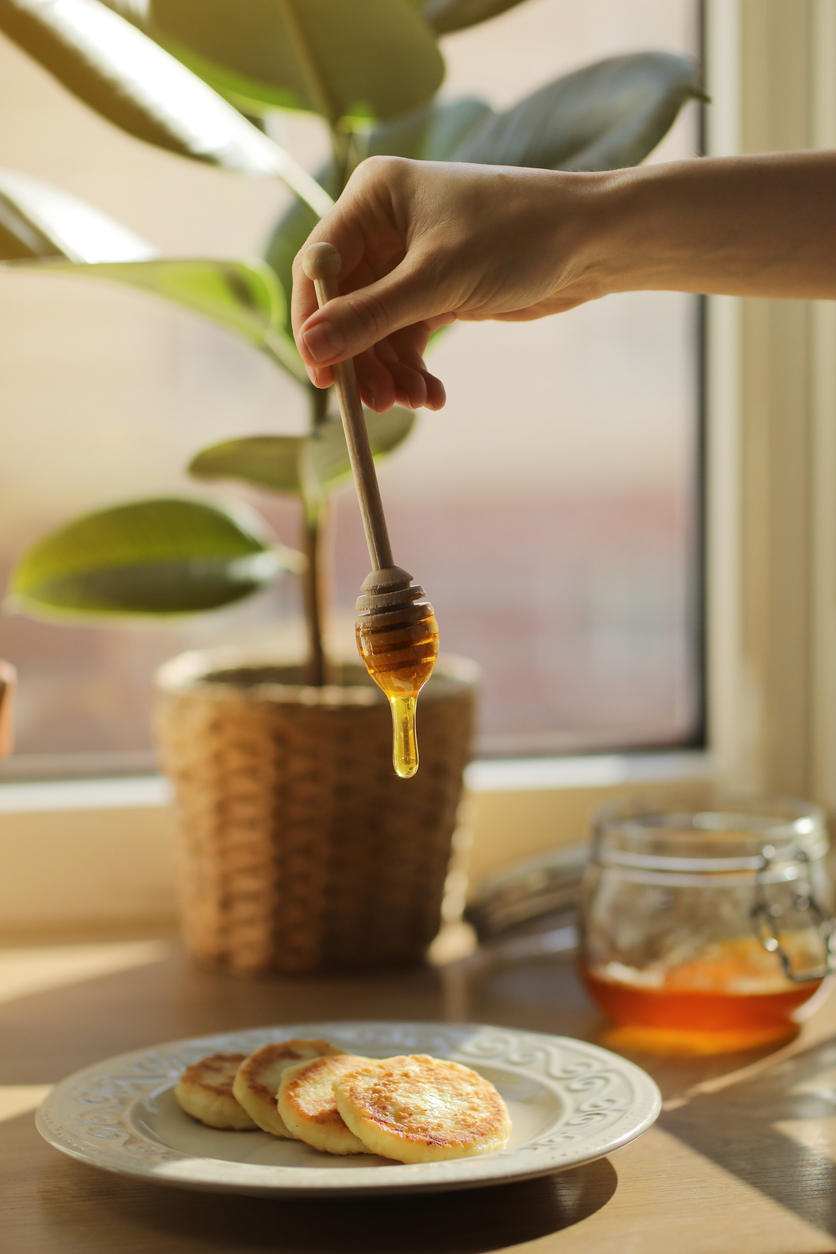
Jarrah (pronounced “yah-rah”) is a special type of honey produced by bees free to roam in Western Australia. These bees forage specifically on the blossom of the Jarrah tree, a member of the myrtle family of trees, native to the most remote parts of Western Australia.
Jarrah trees only flower once every two years, meaning that the blossom is highly prized by local bees, and the resulting honey is highly prized by humans. Since the bees only have a short window in which to produce their honey by collecting nectar and pollen from this rare but beautiful blossom, Jarrah honey is sought after.
Not only is it rare, but Jarrah honey also has unique health properties…
The Antimicrobial Power of Jarrah Honey
Unlike cheaper, mass-produced supermarket honey usually sold in squeezy bottles, Jarrah honey is rich in antimicrobials that can help heal wounds, support the gut and reduce the longevity and severity of coughs and sore throats.
This is all down to the Total Activity, or TA, of Jarrah honey, due to the presence of a compound called hydrogen peroxide. You’d be right if your mind instantly thought of bleach. But at the levels in Jarrah honey, hydrogen peroxide is perfectly safe and is responsible for its health benefits.
You may have heard of Manuka honey, which is arguably better known than Jarrah, hails from New Zealand and is just as prized for its antimicrobial properties. These properties aren’t down to hydrogen peroxide; instead, they’re due to an active component of Manuka called methylglyoxal. Methylglyoxal gives Manuka honey its slightly medicinal taste (which still tastes great) that Jarrah doesn’t have (and also explains why Manuka honey is sometimes referred to as non-peroxide honey).
Of the two, studies show that Jarrah has one of the highest potencies of antimicrobial activityavailable.
Medicinal Benefits of Jarrah Honey
Jarrah honey is used in healthcare settings in dressings used to cover skin wounds and burns that are struggling to heal. It helps to kill the wound-infecting bacteria and forms a physical barrier to prevent other bugs from entering the wound.
Less serious than infected wounds, but the cause of many a miserable winter’s day (and time off work and school), Jarrah honey is fantastic for reducing the pain and irritation of sore throats and coughs. Simply mix a teaspoon with warm water (not boiling, as this will destroy the enzymes responsible for the health benefits) and drink to soothe and calm the throat. It can also be eaten straight from the spoon to coat the throat (or the mouth, if you’re suffering from mouth ulcers).
What Does Jarrah Honey Taste Like?
Darker in colour than other, cheaper honeys (that may just be a flavoured sugar syrup anyway), Jarrah has a caramel taste and is less sweet, ideal if you want the benefits, but you don’t have much of a sweet tooth. This is because Jarrah has lower levels of glucose and higher levels of fructose, a type of natural sugar found in fruits.
Because of this, Jarrah has a lower glycaemic index, or GI. GI is a measure of how quickly the carbohydrate in any given food is metabolised by the body into glucose. Table sugar has the highest GI, of 100, as it’s simply glucose. The lower the GI, the slower the food is turned into glucose and the less likely it is to cause a blood sugar spike (followed by the inevitable crash). Jarrah has a lower GI than sugar and most other honeys.
But don’t just take our word for it. Why don’t you give our Jarrah honey a go, and see for yourself!